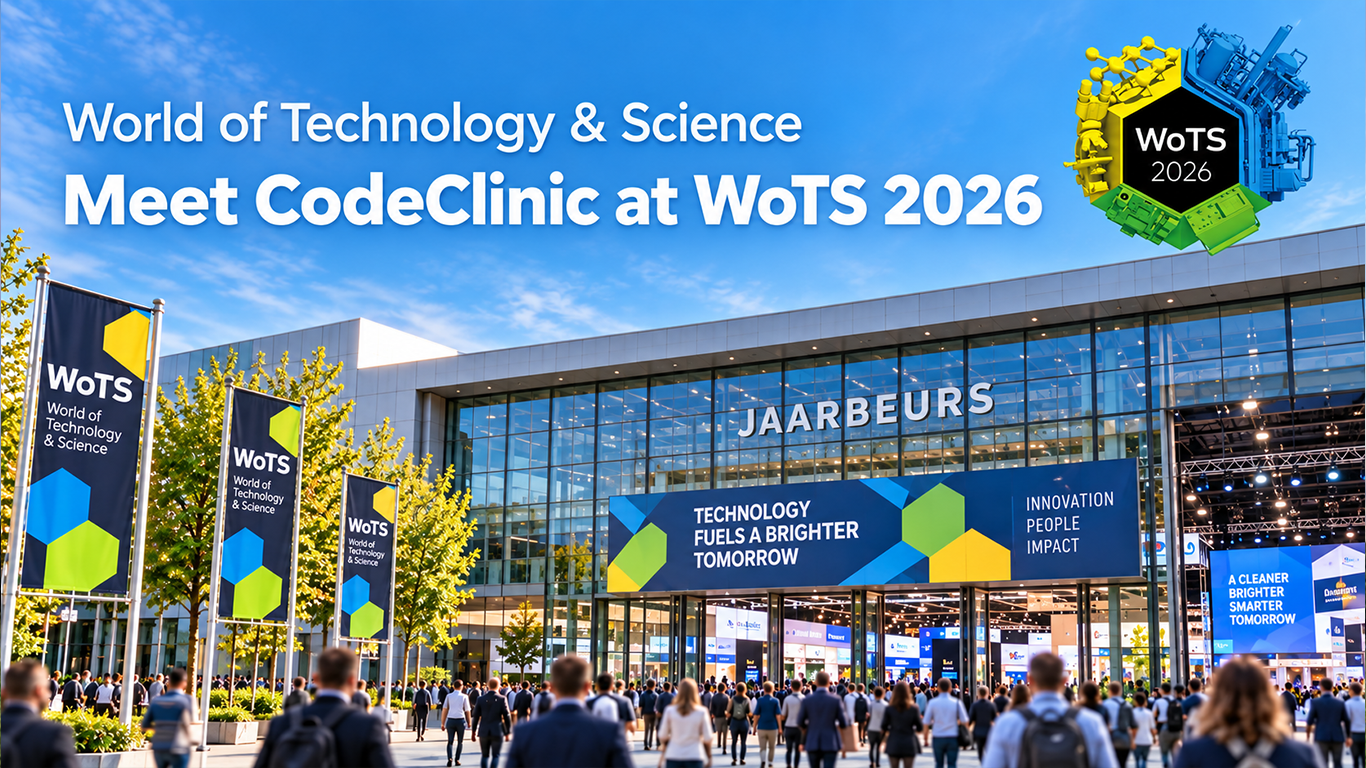
CodeClinic is heading to Utrecht for WoTS 2026 (World of Technology & Science), held September 22–25, 2026 at Jaarbeurs Utrecht in the Netherlands. On the opening day, CodeClinic Co-Founder Neil Langmead will speak in the Embedded Software seminar. He’ll show how AI can help stop software architecture erosion before it takes hold.
About WoTS
WoTS is one of the largest technology trade events in the Benelux, with more than 400 exhibitors showing the latest in industrial technology, electronics, embedded systems and scientific instrumentation. The seminar program brings engineers, architects and technology leaders together to talk about the practical problems in building today’s complex systems.
CodeClinic is taking part through our partner Logic Technology, which is hosting a partner keynote block in the Faraday room.
The Session
AI-Assisted Refactoring for Coupling Reduction: Integrating DSM Analysis with the Model Context Protocol and Reinforcement Learning
- Date: Tuesday, September 22, 2026
- Time: 13:30–14:00
- Location: Faraday room, Jaarbeurs Utrecht
- Speaker: Neil Langmead, Co-Founder, CodeClinic
Over time, as systems evolve, unwanted dependencies build up and layering rules get broken. The code becomes harder to change, test and certify. Neil’s talk introduces an AI-assisted method that tackles this problem head-on. It combines three approaches:
- Dependency Structure Matrix (DSM) analysis to make architectural structure and violations visible
- Large Language Models (LLMs) connected through the Model Context Protocol (MCP) to interpret the architecture, explain why each violation matters, and propose concrete refactorings
- Reinforcement Learning to find refactoring sequences that reduce coupling while keeping tests passing
Neil will present the Recursive Hierarchical Decoupling Algorithm, a systematic approach to reducing coupling. He’ll also explain how the refactoring problem can be framed as a constrained Markov decision process, which lets reinforcement learning agents search for the best sequence of changes. Every change is checked in a CI/CD pipeline for both functional correctness and measurable architectural improvement.
A case study on an embedded systems library shows AI agents finding layer violations, explaining why they matter architecturally, and making changes that bring coupling metrics down.
Who Should Attend
This session is for software architects, embedded engineers, technical leads and engineering managers working with large or long-lived codebases, especially in safety-critical and regulated industries where architectural integrity matters.
Stay for the next session in the same room, too. At 14:00, Dr. Marc Thomas of IAR presents “Trust, but Verify: Keeping AI-Generated Embedded Code Correct, Safe and Compliant.”
Join Us in Utrecht
If you’re attending WoTS, join Neil’s session and talk with the CodeClinic and Logic Technology team about your architecture and technical debt challenges. We’d like to show you how Lattix architecture intelligence and AI-assisted refactoring can help keep your systems modular, maintainable and ready for change.